Extractable Petroleum Hydrocarbons: What They Are and How AALS Puts Them to the Test
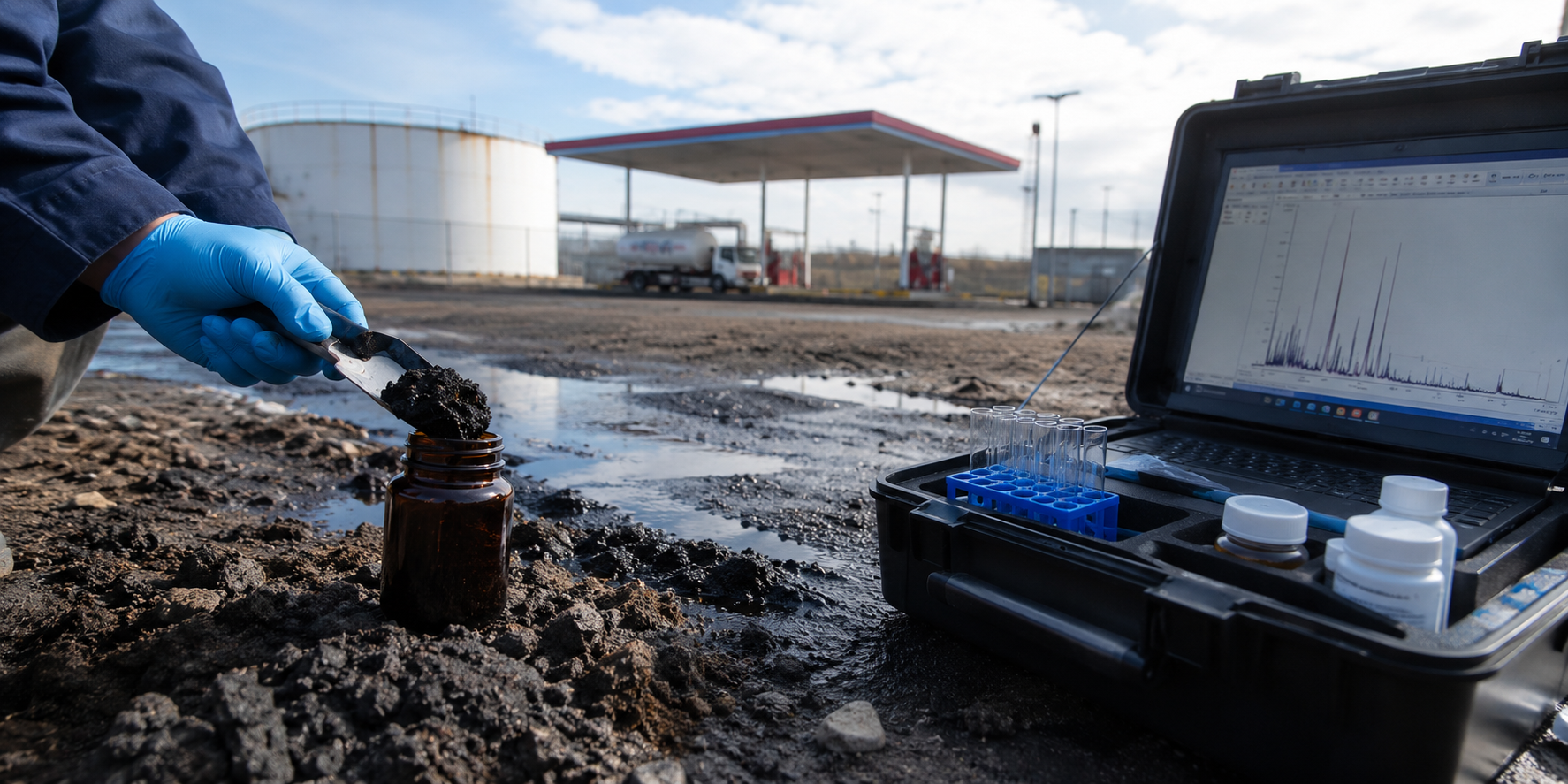
A fuel spill at a filling station. A leaking storage tank at a depot. A parcel of land marked for redevelopment near an old industrial site. In every one of these cases, the question that matters isn't “is there oil in the ground,” it's “how much, and of what kind.” That's the question Extractable Petroleum Hydrocarbon (EPH) testing is built to answer.
At AALS, EPH analysis sits at the centre of the environmental testing we run for oil and gas operators, industrial sites, and remediation projects across Nigeria. This article walks through what EPH actually measures, why the test is built the way it is, and what happens to a sample between the moment it's collected in the field and the moment a figure lands on a lab report.
“Petroleum in soil or water isn't one chemical; it's a mixture of hundreds. EPH testing doesn't try to name each one; it sorts them into groups that line up with how they behave, and how much risk they carry.”
What Extractable Petroleum Hydrocarbons Actually Are?
EPH is made up of two broad families of compounds: aliphatic and aromatic hydrocarbons. Aliphatic compounds are chains of carbon atoms, linked by single, double, or triple bonds, that can be straight, branched, or arranged in a ring. Aromatic compounds are always ring-shaped, built around alternating single and double bonds that give them a distinct chemical stability known as aromaticity.
That structural split matters because the two families don't carry the same weight in a risk assessment. Aromatic compounds, particularly a group known as polynuclear aromatic hydrocarbons (PAHs), tend to raise more health concern at comparable concentrations than their aliphatic counterparts. So rather than reporting a single “total oil” number, EPH methodology reports the two families separately.
Aliphatic hydrocarbons
● Chains of carbon atoms- straight, branched, or cyclic
● Single, double, or triple carbon-carbon bonds
● Includes alkanes, alkenes, and alkynes
● Quantified across two ranges: C9–C18 and C19–C36
Aromatic hydrocarbons
● Always ring-shaped molecules
● Alternating single and double bonds (aromaticity)
● Includes benzene, naphthalene, and PAHs
● Quantified as one range: C11–C22
These carbon-number ranges aren't arbitrary. They correspond to a boiling-point window of roughly 150°C to 500°C, and they line up with the specific hydrocarbon fractions that toxicologists have judged relevant to human exposure. The method is built to support risk assessment, not just chemistry for its own sake.
From Field Sample to Lab Result: How EPH are Monitored?
Reliable EPH data starts long before a sample ever reaches a gas chromatograph. It starts with how the sample is collected, stored, and transported. The requirements below reflect the sample handling rules set out in the current MassDEP EPH Method; the reference protocol AALS methodology draws on for petroleum hydrocarbon testing.
Aqueous samples
● Container: 1-litre amber glass bottle, Teflon-lined screw cap
● Preservation: 5 mL of 1:1 HCl to pH < 2; cool to 0–6°C
● Holding time: extract within 14 days; analyze extract within 40 days of extraction
Soil / sediment (cooled)
● Container: 4-oz. wide-mouth amber glass jar, Teflon-lined screw cap
● Preservation: cool to 0-6°C
● Holding time: extract within 14 days; analyze extract within 40 days of extraction
Soil / sediment (frozen)
● Container: 4-oz. wide-mouth amber glass jar, filled to 2/3 capacity
● Preservation: freeze at -10°C in the field, or cool to 0-6°C and freeze within 24 hours of collection
● Holding time: extract within 14 days of thawing; analyze extract within 40 days of extraction
Why the details matter
● Amber glass, always. Glass is chemically inert and won't react with the sample. Plastic containers are avoided outright, since petroleum hydrocarbons are the feedstock for many plastics, any leaching from the container itself risks a false positive in the result.
● Acid preservation. Lowering aqueous samples to pH < 2 with hydrochloric acid stabilizes the hydrocarbons, slows microbial activity, and keeps certain compounds in a more extractable form.
● Cold, every step. Samples are chilled or frozen from the moment of collection to limit the loss of the more volatile hydrocarbon components and reduce the risk of oxidation before extraction.
● A 14-day clock. Extraction must happen within 14 days of collection (or of thawing, for frozen soil samples) to keep results defensible and comparable across a project.
Inside the Lab: Extraction and Fractionation
Once a sample reaches the lab, it goes through two linked stages before it ever sees a detector: extraction, and fractionation.
Stage 1 Extraction
Extraction → Drying → Concentration → Fractionation
Aqueous samples are typically extracted by separatory funnel or solid-phase extraction; soils and sediments are extracted by Soxhlet or an equivalent method. Extracts are dried over sodium sulfate and concentrated before moving to fractionation.
The sample is extracted with methylene chloride, then solvent-exchanged into hexane and concentrated down to a small, defined volume. At this stage the extract still contains the full mixture of hydrocarbons - aliphatic and aromatic together plus whatever else came out of the sample matrix along with them.
Stage 2 Fractionation
Silica Gel → Split: Aliphatic / Aromatic → Concentration → GC-FID Analysis
The extract is passed through a silica gel cartridge. Hexane elutes the aliphatic fraction; methylene chloride elutes the aromatic fraction. Each is concentrated separately and analyzed on its own chromatographic run.
This is the step that gives EPH testing its name and its precision. The extract is loaded onto a silica gel cartridge, which separates hydrocarbons by polarity rather than by size. Hexane pulls the aliphatic hydrocarbons through; methylene chloride then pulls the aromatic hydrocarbons through separately. Each fraction is concentrated on its own and injected into the gas chromatograph independently meaning every sample is effectively analysed twice, once for each hydrocarbon family.
The chromatograms that come out are read two different ways. Individual Target PAH Analytes - 17 specific compounds with known toxicological significance are identified and measured peak by peak. The remaining aliphatic and aromatic hydrocarbons are measured collectively, as a continuous area under the curve between defined carbon-number markers, which capture the full unresolved mixture rather than just the compounds the method happens to name.
Built-In Quality Checks
Every batch of samples carries its own accuracy check. Before extraction, a known amount of surrogate standard typically 1-chloro-octadecane for the aliphatic side and ortho-terphenyl for the aromatic side is spiked into the sample. After fractionation, a second surrogate, usually 2-bromonaphthalene, confirms that the split between fractions worked as intended. If either surrogate doesn't come back within an acceptable 60-140% recovery window, the result is flagged and the sample may need to be re-extracted or re-fractionated.
Laboratory control samples, method blanks, and duplicate analyses run alongside every batch of field samples, giving a continuous check on precision and bias throughout the process not just a single pass/fail measurement at the end.
Why This Level of Detail Is Worth It
It would be faster to report a single “total petroleum hydrocarbon” number and move on. But a total figure tells you almost nothing about what's in the ground or the water whether it's the lighter, more mobile end of a diesel spill or a heavier, more persistent residual fuel oil, and whether the aromatic fraction carries PAHs that push the risk profile higher. EPH testing exists because remediation decisions, redevelopment signoffs, and regulatory closures all depend on that distinction.
For operators and site owners, that translates directly into better decisions: knowing whether a site needs active remediation or simple monitoring, whether a cleanup has met its target, and whether a parcel of land is safe to build on.
Need ETPH Testing Can You Build a Decision On?
AALS runs Total Petroleum Hydrocarbon testing for oil and gas, industrial, and environmental clients across Nigeria, backed by an ISO/IEC 17025:2017-compliant laboratory. Reach out to discuss soil, sediment, or water sampling for your site.
info@aals.com.ng | www.aals.com.ng | +234 806 217 2155 / +234 806 174 5811
References
- Massachusetts Department of Environmental Protection. (2019). Method for the determination of extractable petroleum hydrocarbons (EPH) (MassDEP-EPH-19-2.1, Rev. 2.1).
- Massachusetts Department of Environmental Protection. WSC-CAM-IV B — Quality control requirements and performance standards for extractable petroleum hydrocarbons (EPH).